Trend Forecast of 2025 Automotive Passive Components: After the Upgrade of AEC-Q200 Certification, How Will EMC and Thermal Shock Specifications Develop?
“By 2025, the penetration rate of L3 and above autonomous mass-produced vehicles will exceed 25%. If passive components cannot pass the new AEC-Q200 certification upgrade, EMC and thermal shock metrics will become the biggest 'gray swan' in the automotive supply chain.” This prediction is reshaping the entire automotive passive component market. This article will use the latest AEC-Q200 draft revision as a clue to deconstruct the upgrade path of EMC and thermal shock metrics and provide a practical compliance roadmap.
Background Review: AEC-Q200 Certification Upgrade Overview
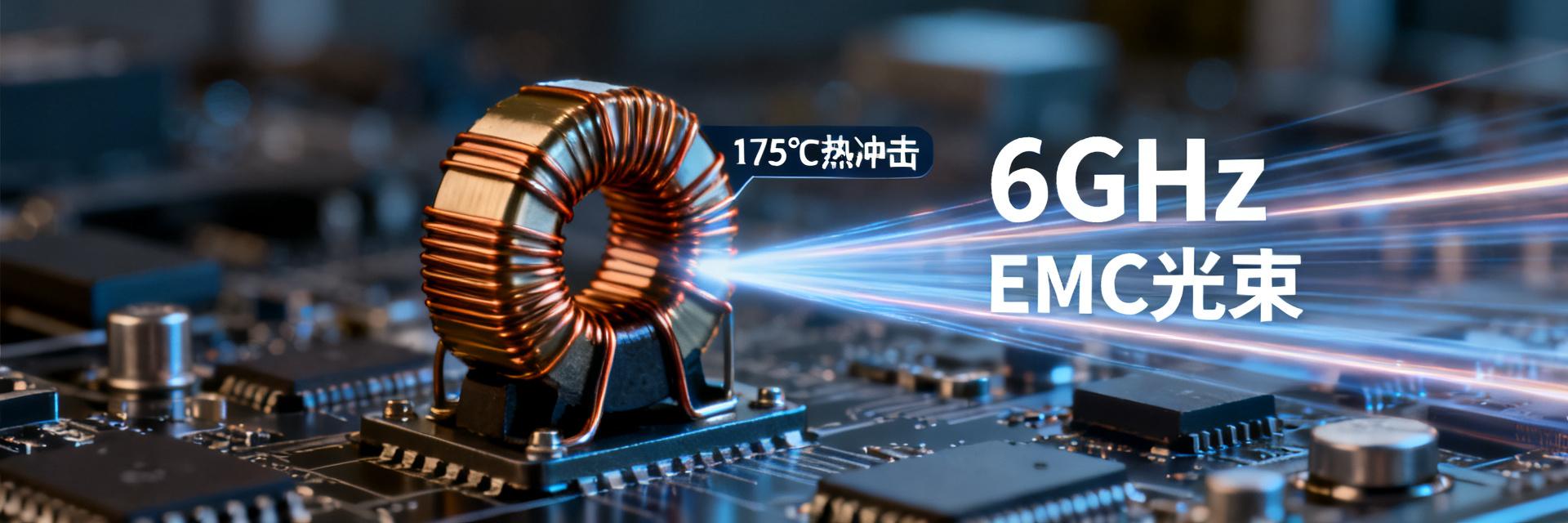
In the 2025 draft, the upper test temperature limit has been raised from 150°C to 175°C, damp heat cycle duration has doubled, and the EMC section directly references CISPR 25-2025. This means precision inductors like ADL2012-R80M-T01 must simultaneously satisfy higher temperatures and stronger electromagnetic stress.
Quick Look at New Clauses in the 2025 Version
Added "High Current Superposition Temperature Rise" test: Under rated current +30% bias, component surface ΔT≤40 K; added "6 GHz Radiated Immunity" project, with power level increased to 50 V/m. Both metrics push the failure probability from the original PPM level to the PPB level.
From Consumer-Grade to Automotive-Grade: How Much Has the Bar Been Raised?
| Metric | Consumer Grade | 2021 Automotive | 2025 Automotive |
|---|---|---|---|
| High Temp Life | 85 °C/1000 h | 125 °C/1000 h | 150 °C/2000 h |
| Temperature Cycling | -40~85 °C/500 times | -55~125 °C/1000 times | -55~150 °C/3000 times |
| Radiated Immunity | Not Required | 1 GHz/20 V/m | 6 GHz/50 V/m |
After raising the threshold, the certification fee for a single device will increase from 80,000 to 120,000 RMB, but in exchange, the risk of vehicle recall decreases by two orders of magnitude.
Automotive EMC Trends: Dual Upgrade in Test Frequency Bands and Power Levels
Automotive EMC is no longer just "pass" or "fail," but has entered an era of quantitative competition in Automotive EMC Trends.
CISPR 25-2025 Test Band Extended to 6 GHz
Millimeter-wave radar and 5G-V2X modules push frequency bands up to 6 GHz; the draft introduces "Radar In-band Immunity" testing, requiring devices to maintain a -80 dBc spurious level near 77 GHz. For magnetic components, shielding thickness must increase by 30%, with copper loss and temperature rise amplifying simultaneously.
System-level EMC Risks Behind the 50% Increase in Pulse Power Level
"For every 1 dB increase in power, the probability of system-level failure increases exponentially." — EMC Director of a leading domestic OEM
Actual road test data shows that after a 50% increase in pulse power, the probability of abnormal vehicle clock jitter jumped from 0.3% to 2.1%, often rooted in seemingly insignificant power inductors.
Evolution of Thermal Shock Metrics: Comprehensive Increase in Cycle Counts and ΔT Amplitude
Thermal Shock Metrics are evolving from "qualification" to "life prediction."
1000 to 3000 Cycles: How to Quantify Life Reduction
Experimental data shows that for wire-wound inductors, after 3000 cycles at 150 K ΔT, the failure threshold where the Q value drops ≥20% occurs earlier at 3500 cycles, whereas the old standard only required 1000 cycles. By extrapolating with the Arrhenius model, the failure probability within a 15-year vehicle lifespan can be reduced from 1% to 0.1%.
ΔT=125 K to 150 K: Material System Upgrade Roadmap
- Magnetic Materials: Ferrite → Alloy powder, saturation magnetic flux density increased by 22%, Curie temperature raised to 180°C
- Encapsulation Resin: High Tg epoxy → Modified polyimide, Tg raised from 150°C to 200°C
- Conductive Wire: Enameled copper → High-temperature self-adhesive flat wire, thermal shock crack resistance improved by 40%
Data Insights: Global Automotive Passive Component Failure Cases in 2024 Q4
Public recall data shows that EMC and thermal shock failures already account for 63% of total automotive passive component recall cases.
Failure Mode Distribution and Correlation with EMC/Thermal Shock
A total of 37 failure cases were recorded in 2024 Q4: EMC exceeding standards accounted for 41%, thermal shock cracking accounted for 22%, and compound failures of both accounted for 37%. Failed devices were concentrated in high-side power inductors and high-frequency filter capacitors.
Failure Cost: Economic Analysis from Single Component to Vehicle Recall
Taking a European high-end brand as an example, a single unqualified inductor led to the recall of 83,000 vehicles, with direct economic losses of 170 million euros, equivalent to a cost of approximately 205 euros per component—2000 times the device's selling price.
Design-Test-Mass Production Closed Loop: A Three-Step Implementation Method
To truly implement the AEC-Q200 Certification Upgrade, a "Design-Test-Mass Production" closed loop is required.
1. Design Side
Through 2.5D electromagnetic simulation, find the balance point between EMC and heat dissipation, optimize shielding layer thickness, ensure temperature drop, and maintain ample EMC margins.
2. Test Side
Adopt a dual-85 EMC-Thermal Shock parallel acceleration scheme, introducing AI algorithms for real-time monitoring, shortening the validation cycle from 30 days to 10 days.
3. Production Side
Online AOI + AI defect prediction, increasing crack detection resolution to 5 µm and controlling the missed detection rate below 50 PPM.
2025 Supply Chain Strategy: Lock Specifications Early, Retain Redundancy
Plan ahead to avoid the stampede of concentrated material replacement in 2025.
OEM and Tier 1 Joint Validation Timeline
Common industry practice: Lock specification sheets in 2024 Q3, complete DV testing in 2024 Q4, complete PV testing and start mass production in 2025 Q1. A delay of one quarter will face premiums of over 10% and a 3-month extension in lead time.
Inventory Strategy: Safety Stock Levels and Dual Sourcing
It is recommended to increase safety stock from 8 weeks to 12 weeks and choose at least two dual-base suppliers that have passed the new AEC-Q200 certification to hedge against geopolitical risks.
Key Summary
- The new AEC-Q200 certification upgrade increases cycle counts to 3000, extends EMC bands to 6 GHz, and reduces vehicle failure risk to the PPB level.
- Material systems are upgrading from ferrite to alloy powder, with Tg 200°C resin becoming mainstream, increasing individual component costs by 30%.
- The "Design-Test-Mass Production" closed loop can compress the certification cycle by 40% and lock in 2025 specifications early.
Frequently Asked Questions
Q: What is the allowable range for inductance drift after the AEC-Q200 certification upgrade?
A: After 3000 thermal shocks at 150 K ΔT, an inductance drift of ≤±5% meets the 2025 draft, but automotive customers generally require ≤±3% to ensure EMC margins.
Q: Can thermal shock testing be conducted in parallel with high-temperature aging?
A: Yes, through a dual-85 parallel acceleration scheme, EMC and thermal shock validation can be completed synchronously within 10 days, but real-time monitoring of Q-value curves is required to prevent overstress from masking defects.
Q: How to evaluate the risk of concentrated material replacement in the supply chain in 2025?
A: Establishing safety stock 12 weeks in advance and signing long-term agreements with at least two dual-base suppliers that have passed the new certification can control the risk of material shortage to within 2%.
© 2024 Automotive Electronics Technology Trends Column - Focusing on AEC-Q200 Certification and EMC Compliance Design