The latest data report: the reliability of conductive polymer mixed aluminum electrolytic capacitor is improved by over 70%, and its life is prolonged by 3 times.
In the electronics industry's pursuit of higher energy efficiency and more compact designs, the reliability of core components remains a critical challenge for engineers. Hybrid aluminum electrolytic capacitors using conductive polymers as cathode materials are reshaping the competitive landscape of the high-reliability power supply and automotive electronics markets.
Compared to traditional liquid electrolyte products
Under 105°C high-temperature testing environment
Technical Analysis: What are Conductive Polymer Hybrid Aluminum Electrolytic Capacitors
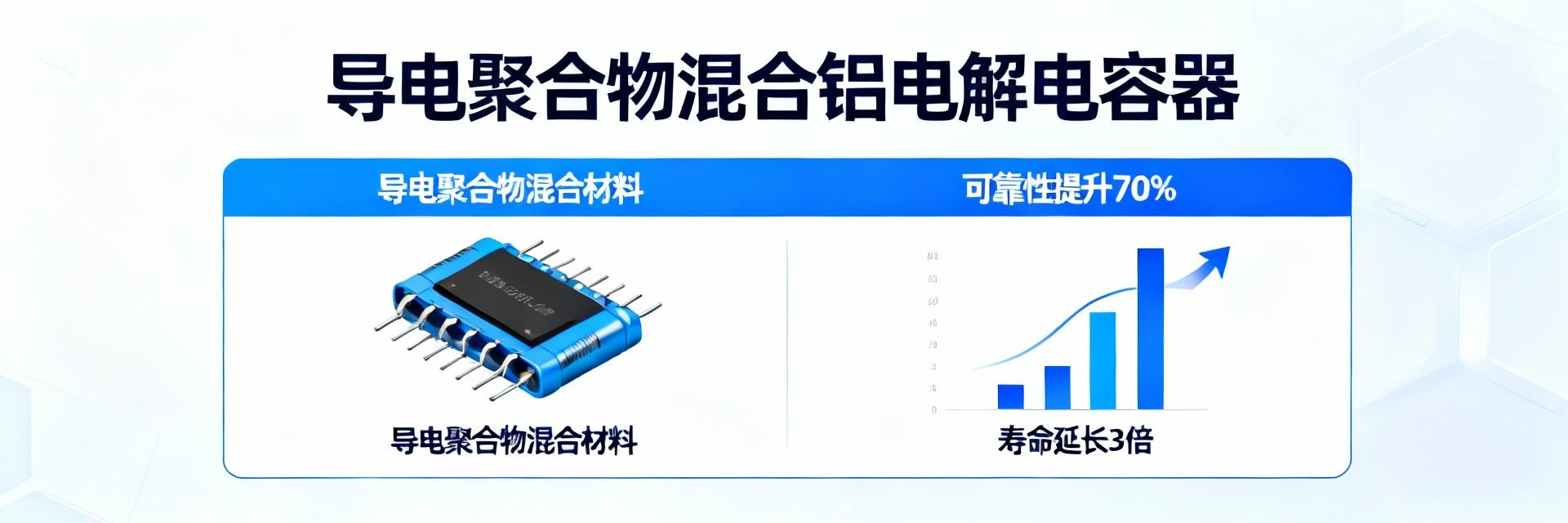
To understand their leap in performance, one must first analyze their core structure. Traditional liquid aluminum electrolytic capacitors use a liquid electrolyte impregnated in electrolytic paper as the cathode material. Hybrid capacitors, as the name suggests, introduce a solid conductive polymer as part or all of the cathode material between the anode aluminum oxide foil and the electrolytic paper.
Core Structure: The "Hybrid" Mystery of Traditional Liquid Electrolyte and Solid Conductive Polymer
This "hybrid" is not a simple physical superposition. A typical structure retains a portion of traditional electrolyte in the electrolytic paper near the anode foil, while the side near the cathode foil is filled with high-conductivity polymer materials such as polypyrrole or polyaniline. This design cleverly combines the self-healing capability of the liquid electrolyte for oxide film defects with the extremely low Equivalent Series Resistance (ESR) and excellent high-frequency characteristics of the solid polymer.
Performance Leap: Reliability Transition from "Weak Link" to "Strong Combination"
The lifespan and reliability of traditional liquid electrolytic capacitors are largely limited by the drying and oxidation of the electrolyte. At high temperatures, the electrolyte evaporates faster, leading to capacitance decay, rising ESR, and eventual failure. The introduction of conductive polymers fundamentally reduces the volatile liquid components, thereby significantly enhancing high-temperature stability. This "strong combination" structure allows the capacitor to demonstrate a qualitative leap when dealing with harsh operating conditions such as high temperatures and high ripple currents.
Data Deep Dive: Behind the 70% Reliability Boost and 3x Lifespan Extension
| Test Metric | Traditional Liquid Capacitor | Conductive Polymer Hybrid | Performance Improvement |
|---|---|---|---|
| 105°C Rated Life | 2,000 - 3,000 hours | 8,000 - 10,000 hours | +300% |
| Average Failure Rate (FIT) | Baseline | 30% of Baseline | -70% |
| ESR Stability (125°C) | Increases exponentially over time | Remains extremely stable throughout | Significant Enhancement |
| Vibration Resistance | Standard | Excellent (Solid Support) | Physical-level Reinforcement |
Failure Mechanism Comparison: Why Can Conductive Polymers Drastically Reduce Failure Rates?
The primary failure mode of liquid electrolytic capacitors is the sharp increase in internal resistance caused by electrolyte drying. In a hybrid structure, the solid polymer itself is non-volatile and highly stable, and the remaining small amount of liquid electrolyte is partially "sealed" by the polymer, slowing down the loss rate. Additionally, the polymer cathode provides superior resistance to mechanical vibration and thermal shock, further reducing the risk of failure due to physical stress.
Application Scenario Revolution: Which Fields Will Benefit First?
Automotive Electronics: A Must-Have for Engine Bay High Temperatures
ECUs, LED headlight drivers, and DC-DC converters located in the engine bay face challenges up to 125°C. Hybrid capacitors significantly improve the durability of automotive power supplies, perfectly meeting the long-life requirements for basic components in automotive electrification.
Industrial Power Supplies & Servers: The Key to MTBF
In data centers and communication base stations, Mean Time Between Failures (MTBF) is a core metric. Using hybrid aluminum electrolytic capacitors can significantly reduce the early failure rate of power modules, extend maintenance cycles, and lower the total cost of ownership.
Design Selection Guide: How to Properly Apply Hybrid Capacitors
Key Parameter Trade-offs
Selection requires a comprehensive evaluation. Hybrid capacitors have lower ESR and better high-frequency performance, but their capacitance per unit volume may be slightly lower than liquid products of the same size. Therefore, in filtering applications, fewer hybrid capacitors may achieve better ripple suppression.
Circuit Design Considerations
When designing the PCB layout, minimize lead lengths to reduce parasitic inductance. Due to their excellent impedance characteristics at high frequencies, they are very suitable for high-frequency output filtering in switching power supplies, effectively reducing output ripple voltage.
Core Summary
- ● Structural Innovation: Uses a "solid polymer + liquid electrolyte" composite cathode, combining self-healing ability with stability.
- ● Performance Breakthrough: Average failure rate reduced by approximately 70%, with lifespan extended by over 3 times at 105°C.
- ● Application Focus: Targets harsh environments such as automotive electronics and industrial power, significantly improving system-level MTBF.
- ● Design Optimization: Leverages low ESR characteristics to optimize PCB layout, balancing capacitance, voltage, and life curves.
Frequently Asked Questions (FAQ)
Can conductive polymer hybrid aluminum electrolytic capacitors directly replace traditional liquid electrolytic capacitors?
In most cases, yes, but it is not always a simple one-to-one replacement. Because hybrid capacitors have lower ESR, engineers need to re-evaluate the filtering effect. Sometimes, a smaller capacitance can achieve the same performance, resulting in space savings. It is recommended to consult the datasheet and verify in the actual circuit.
Besides automotive and industrial fields, what are other potential applications?
The application prospects are broad. These include high-end consumer electronics (game consoles, graphics card VRMs), new energy sectors (photovoltaic inverters, energy storage systems), as well as medical equipment and aerospace electronics where reliability standards are stringent.
How to evaluate the cost-effectiveness of hybrid capacitors in a specific project?
A full lifecycle cost analysis should be conducted. Although the unit price is slightly higher, the resulting improvement in system reliability can significantly reduce after-sales repair rates, extend warranty periods, and decrease downtime losses. For high-value projects, the comprehensive cost-benefit is often very prominent.