2025 Mainstream Conductive Polymer Capacitor Horizontal Review: Why is PCW0E182MCO1GS the first choice for automotive grades?
With the rapid development of new energy vehicles and intelligent driving, the reliability requirements for automotive-grade electronic components have reached unprecedented heights. Among many key devices, conductive polymer capacitors have become the "heart"-level choice for core modules.
This article will provide an in-depth horizontal comparison of current mainstream conductive polymer capacitors, focusing on the star model PCW0E182MCO1GS, and dismantle through data why it stands out in rigorous automotive applications to become the default choice for engineers.
Automotive-Grade Conductive Polymer Capacitors: 2025 Market and Technology Panorama
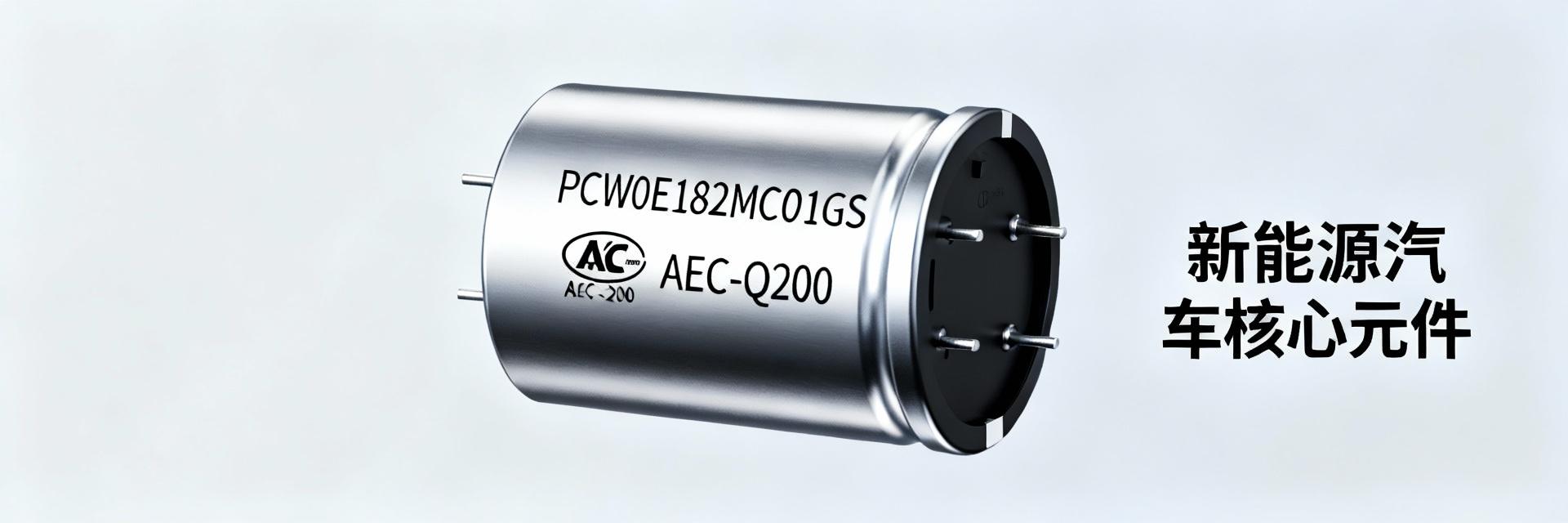
In the field of automotive electronics, the leap from consumer-grade to automotive-grade is not a simple parameter upgrade, but the construction of an entire reliability system. AEC-Q200 certification is precisely the benchmark of this gap, ensuring that components can work stably throughout the vehicle's entire life cycle.
From Consumer-Grade to Automotive-Grade: The Gap and Significance of AEC-Q200 Certification
The core of AEC-Q200 certification lies in verifying the long-term reliability of components. It requires that the performance attenuation of capacitors must remain within the specified range under extreme conditions such as high temperature and high humidity, temperature cycling, and mechanical shock. This directly eliminates consumer-grade products with insufficient long-term stability.
Interpretation of Core Performance Indicators: Why ESR, Ripple Current, and Lifespan are the Keys to Success?
Low ESR means lower energy loss and heat generation; high ripple current tolerance determines stability under frequent charge and discharge conditions; and load life at 125°C is key to predicting whether a component can last more than 15 years in extreme environments.
In-depth Comparison: Key Data Comparison of Mainstream Conductive Polymer Capacitors
Electrical Performance Arena: Horizontal Comparison of Capacity, Voltage, ESR, and Ripple Current Capability
| Comparison Item | PCW0E182MCO1GS | Typical Competitor A | Typical Competitor B |
|---|---|---|---|
| Rated Capacity/Voltage | 1800μF / 2.5V | 1800μF / 2.5V | 1800μF / 2.5V |
| Typical ESR (20°C, 100kHz) | 13 mΩ | 18 mΩ | 15 mΩ |
| Rated Ripple Current | Superior | Medium | Medium-High |
ESR Performance Visualization Comparison (Lower Values are Better)
Environmental Reliability Test: High-Temperature Load Life, Temperature Resistance Range, and Mechanical Strength Analysis
PCW0E182MCO1GS provides load life test data of up to 2000 hours at 125°C, far exceeding basic AEC-Q200 requirements. Its operating temperature range covers -55°C to +125°C, calmly dealing with full-scenario temperature challenges.
Focus Analysis: The "Automotive-Grade" Genes of PCW0E182MCO1GS
Hard Strength Behind the Datasheet
The parameters "1800μF/2.5V, 13mΩ ESR" imply extremely high energy density. This makes it particularly suitable for powering processors with dramatic transient load changes, allowing it to respond quickly to current demands and suppress voltage drops.
Design Details and Craftsmanship
Using high-conductivity polymer as the cathode material fundamentally eliminates the risk of electrolyte drying. Its packaging process uses high-temperature-resistant, anti-aging materials and undergoes strict sealing treatment to ensure consistent performance in harsh environments.
Typical Application Scenarios and Selection Guide
- [•] New Energy Vehicle Three-Electric System: Used for control unit filtering in BMS; provides decoupling and energy storage for core processors in MCU and VCU, with its low ESR characteristic helping to reduce switching losses.
- [•] ADAS Domain Controller: In intelligent driving modules, its excellent ripple suppression capability provides a "quiet" power environment for high-computational chips.
- [•] Selection Pitfall Guide: Do not just look at capacity. The required ESR should be calculated based on the maximum ripple current, and load life at the highest temperature should be used as an important basis.
Future Trends and Supply Chain Considerations
The main technical line in 2025 remains the pursuit of higher energy density and lower losses. Ensuring the supply security of key components is an important topic in the automotive industry chain; engineers must weigh performance, reliability, supply security, and cost when selecting components.
Key Summary
- Automotive Certification is the Foundation: PCW0E182MCO1GS passed AEC-Q200 certification, which is the entry ticket for meeting high reliability needs.
- The Performance Iron Triangle: Low ESR (13mΩ), high ripple current, and long high-temperature life are the core metrics for evaluation.
- Matching Application Scenarios: In systems such as BMS, VCU, and ADAS, priority should be given to products with full automotive-grade data support.